Easiest Sourdough Bread Recipe
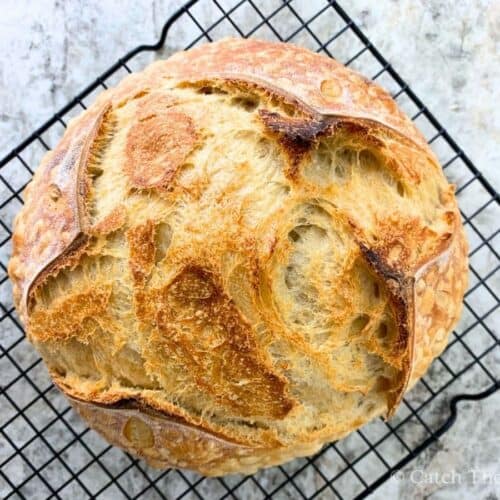
This is the easiest sourdough bread recipe for beginners. No complicated steps, just real bread made simply. With a few basic ingredients, you’ll learn the best way to mix, rise, shape, and bake your first loaf of sourdough bread at home. It’s perfect for beginner bakers who want fresh bread without the overwhelm. Ready to bake your first loaf of sourdough bread? Let’s go!
Print Recipe
Ingredients
- 75g active sourdough starter (fed and bubbly)
- 330g warm water (about 90°F)
- 500g unbleached all-purpose flour
- 10g sea salt
Instructions
- The night before, feed your starter using a 1:5:5 ratio (10g starter + 50g flour + 50g water). Let it sit at room temp until doubled, airy, and just starting to flatten on top. Generally your starter will take about 10-12 hours using a 1:5:5 ratio. Tip: A spoonful should float in water when it’s ready (float test).
- In a large bowl, stir together 330g warm water (around 90°F) and 75g active starter until cloudy. Add 500g all-purpose flour and 10g salt. Mix until all dry bits are gone and a shaggy dough forms. Take note of the time, this is the start of bulk fermentation. Cover and rest for 1 hour.
- Perform 3 - 4 sets of stretch and folds, 30 minutes apart, take the temperature of your dough after each stretch and fold. We are aiming to keep our dough around 78–80°F. After your final set, cover the dough and let it rise until it looks puffy, jiggly, and bubbly (typically 4–5 hours total from the time that all ingredients have been mixed at 78–80°F).
- Gently turn dough onto a lightly floured surface and shape into a loose round. Let it rest uncovered for 20 minutes.
- Flip the dough over, fold in all 4 sides, then flip back so the seam is down. Use your hands to tighten into a smooth round. Place seam side up into a floured banneton or towel-lined bowl.
- Cover and refrigerate overnight (up to 48 hours). This slows fermentation, deepens flavor, and makes the dough easier to bake.
- Preheat oven to 450°F (232°C) with a Dutch oven inside for at least 30 minutes. Place a heavy duty baking sheet on the rack below your dutch over, this helps the bottom of your loaf from getting too brown. Flip dough onto the parchment paper, score, and carefully place in the hot Dutch oven. Bake covered for 30 minutes, then uncover and bake for 12–15 minutes until deep golden brown and 205 - 210°F internally.
- Let your loaf cool on a wire rack for at least 1 - 2 hours before slicing. Slicing too soon can lead to a gummy interior.
Notes
- For best results, use a kitchen scale to weigh all ingredients. Accuracy makes a big difference.
- Dough temperature is key! If your kitchen is cool, try using slightly warmer water or placing your bowl in a warmer spot.
- The surface of the dough should feel smooth and elastic after bulk fermentation.
- If you’re making your first loaf of sourdough bread, it’s a good thing to jot down what worked and what you’d try differently next time.
Servings: 1 loaf